


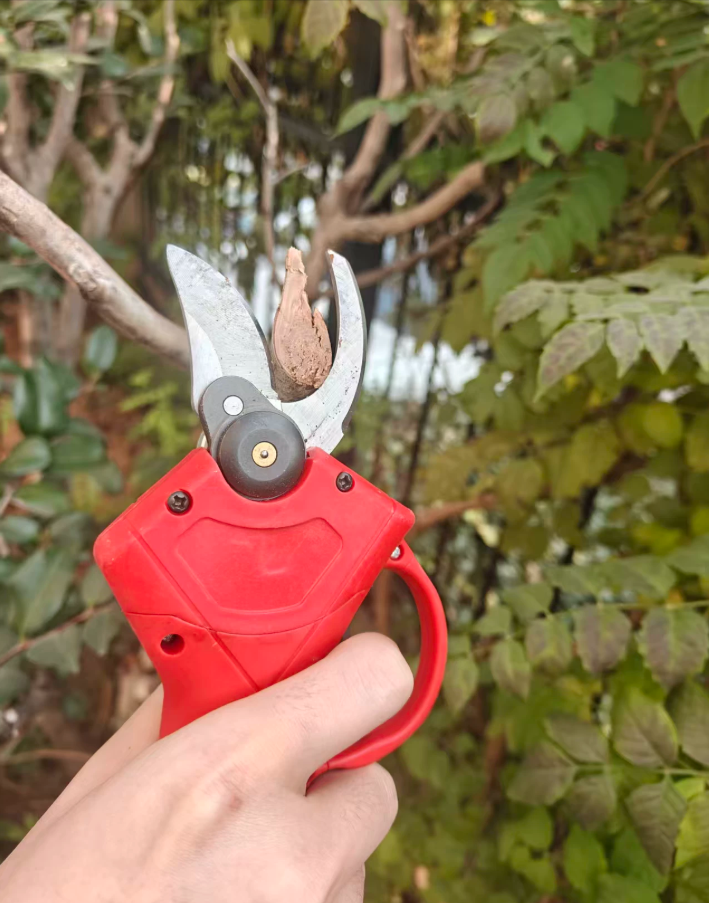
Not every branch should be cut in the same way. In orchards, vineyards, gardens, and nurseries, branch diameter, wood hardness, cutting position, and plant condition can all affect the pruning process.
Using electric pruning shears correctly for different branch sizes can help workers achieve cleaner cuts and avoid unnecessary stress on the cutting mechanism.
Start with Small Branches
Young shoots and thin branches are usually the easiest material to prune.
Position the branch close to the inner area of the blade rather than trying to cut with only the blade tip. This gives the cutting mechanism better control and helps create a cleaner cutting surface.
Small branches are common when pruning:
- Grapevines
- Young fruit trees
- Flowers
- Shrubs
- Nursery plants
- New seasonal growth
For repetitive work, electric pruning shears allow the operator to move quickly from one branch to the next without repeatedly squeezing a manual handle.
Medium Branches Need Better Positioning
As branch diameter increases, correct positioning becomes more important.
Before pressing the trigger, make sure the branch is fully inside the cutting opening and positioned securely between the blades.
Avoid cutting at an extreme angle whenever possible.
A stable cutting position can help reduce unnecessary sideways pressure on the blade.
For orchard work, medium branches are often found during seasonal canopy management, branch renewal, and shaping.
Do Not Force Oversized Branches
Every electric pruning shear has a designed cutting capacity.
If a branch is larger than the recommended maximum opening, forcing the tool through it may place unnecessary load on the motor, gearbox, or blade.
For thicker wood, use a larger pruning tool or pruning saw instead.
Professional users should choose their electric pruning shear according to the typical branch diameter found in their orchard or vineyard.
Build an Efficient Pruning Sequence
When pruning a tree or vine, it can be helpful to work in a logical order.
Start by removing:
- Dead or damaged branches
- Unwanted small shoots
- Crossing branches
- Excess growth inside the canopy
- Branches that interfere with the desired plant shape
This approach makes the plant structure easier to see as the job progresses.
Instead of cutting randomly, workers can gradually open the canopy and decide which branches should remain.
Keep the Blade Clean During Work
Plant sap and fine wood particles can accumulate on the blade during repeated pruning.
A dirty blade may increase cutting resistance.
Check the cutting area regularly and remove residue according to the tool manufacturer’s maintenance instructions.
Keeping the blade clean is especially useful when working with fruit trees or plants that produce sticky sap.
Check Blade Sharpness Before Heavy Pruning
A sharp blade requires less effort to pass through wood.
Before the main pruning season, inspect the blade edge for:
- Chips
- Excessive wear
- Deformation
- Heavy residue
- Loose mounting components
Replace or service worn parts when necessary.
For professional growers, preparing spare blades before the busy season can help prevent unnecessary downtime.
Battery Planning for Larger Orchards
Battery preparation is also part of an efficient pruning workflow.
Before entering a large orchard or vineyard, make sure batteries are fully charged.
For long working days, an additional battery may allow one battery to be charged while another is being used.
Actual working time will vary depending on battery capacity, branch thickness, cutting frequency, temperature, and tool configuration.
Match the Tool to the Job
The best electric pruning shear is not simply the model with the largest cutting opening.
Growers should consider:
Branch Diameter – What size branches are normally cut?
Tool Weight – Will the operator use it for several hours?
Battery Configuration – Is longer working time required?
Blade Availability – Can replacement blades be purchased easily?
Spare Parts – Are maintenance components available?
Matching the tool to the actual pruning job can provide a better experience than choosing only by power or appearance.
A Practical Tool for Modern Pruning Work
Electric pruning shears are especially useful when pruning requires hundreds or thousands of repeated cuts.
Correct branch positioning, suitable cutting capacity, sharp blades, and proper battery preparation can help workers maintain a consistent pruning workflow throughout the season.
WUGENG supplies electric pruning shears for orchards, vineyards, nurseries, gardening, and agricultural applications.
发表回复