




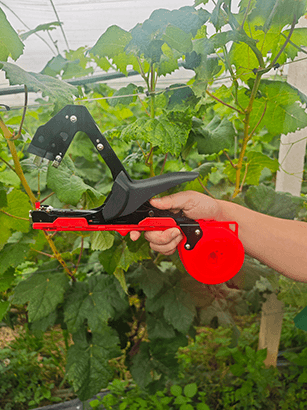
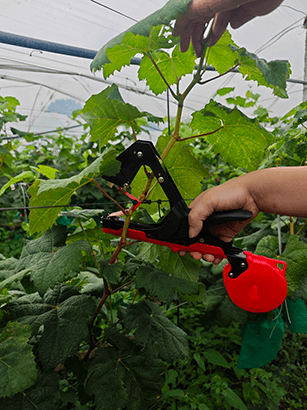
Supporting climbing plants is an essential task in vineyards, greenhouses, vegetable farms, and nurseries. Grapevines, tomatoes, cucumbers, peppers, and flowers often need to be fixed to stakes, wires, or trellises so that they can grow in the correct direction.
However, tying every plant by hand can be slow and tiring. A manual plant tying tool provides growers with a faster and more consistent way to complete this work.
Why Is Plant Tying Important?
Proper plant tying helps keep stems upright and prevents vines from falling onto the ground. It also makes planting rows easier to manage and can improve airflow, sunlight exposure, harvesting, spraying, and daily crop inspection.
Without adequate support, plants may become tangled, damaged, or difficult to maintain. For commercial growers, this can increase labor requirements and reduce working efficiency.
A plant tying tool helps secure plants to their supports while leaving enough space for continued stem growth.
What Is a Manual Plant Tying Tool?
A manual plant tying tool, also known as a plant tapener, is a handheld tool used to fasten plants to stakes, trellis wires, or support frames.
It normally uses plant tying tape and compatible staples. During operation, the tool wraps the tape around the plant and support, staples the tape, and cuts it in one action.
This simple process allows workers to complete repeated tying tasks more quickly than traditional hand tying.
Key Benefits for Professional Growers
Faster Tying Work
A plant tying tool can complete one tie in only a few seconds. This is especially useful during the growing season when thousands of plants may need to be supported within a limited period.
Reduced Repetitive Labor
Traditional tying requires workers to cut string, wrap it around the stem, make a knot, and repeat the process. A tapener simplifies these steps and reduces repetitive hand movements.
Consistent Tying Results
The tool creates similar loops across planting rows. Consistent ties help farms and greenhouses maintain a cleaner and more organized appearance.
Easy One-Hand Operation
Most manual plant tapeners can be operated with one hand. The other hand can be used to position the plant stem, hold the support wire, or separate nearby leaves.
No Electricity Required
The tool does not require batteries, charging, compressed air, or electrical power. It can be used directly in fields, vineyards, greenhouses, and remote growing areas.
Portable and Lightweight
Its compact design makes it easy to carry while moving between planting rows. Growers can also keep extra tape and staples in a tool bag for continuous work.
Where Can a Plant Tying Tool Be Used?
The plant tying tool is suitable for many crops and agricultural applications.
Common applications include:
- Grapevines
- Tomato plants
- Cucumber vines
- Pepper plants
- Eggplants
- Melon vines
- Raspberry plants
- Blackberry plants
- Roses
- Climbing flowers
- Nursery seedlings
- Young orchard trees
It can be used in vineyards, greenhouses, orchards, nurseries, vegetable farms, gardens, and landscaping projects.
How to Use a Plant Tapener
Using a manual plant tying tool is simple.
- Open the tape compartment and install the tying tape.
- Pull the tape through the guide position.
- Load compatible staples into the staple channel.
- Press the handle lightly to catch the tape.
- Position the plant stem and support wire inside the tool opening.
- Press the handle completely.
- The tape will be wrapped, stapled, and cut.
- Check that the tie supports the plant without being too tight.
When tying young stems, growers should always leave enough room for future plant growth.
Choosing the Right Tying Tape
Plant tying tapes are available in different widths, thicknesses, colors, and materials.
The correct tape depends on the crop, plant size, growing cycle, and environmental conditions. Soft and flexible tape is suitable for tender stems, while stronger tape may be required for heavier vines or outdoor applications.
Customers should also check whether they need standard tape, thicker tape, UV-resistant tape, or degradable tape.
Common Accessories
A complete plant tying system may include:
- Manual plant tying tool
- Plant tying tape
- Compatible staples
- Replacement blade
- Replacement spring
- Tape guide parts
- Staple pusher
- Maintenance accessories
Keeping spare blades, tape, and staples available can reduce downtime during busy agricultural seasons.
Maintenance and Cleaning
Regular maintenance helps keep the plant tying tool operating smoothly.
After use:
- Remove broken tape pieces.
- Clean the staple channel.
- Check whether the blade is sharp.
- Remove soil, plant sap, and moisture.
- Store the tool in a dry place.
- Apply a small amount of lubricant to moving parts when necessary.
- Replace damaged springs or blades promptly.
Do not force the handle when the tool is jammed. Open the tool and remove the blocked staple or tape before continuing.
Manual Plant Tying Tool vs. Traditional Hand Tying
Traditional hand tying is suitable for small gardens, but it may become inefficient for large planting areas.
A manual plant tying tool offers several advantages:
- Faster operation
- More uniform ties
- Easier one-hand use
- Less time spent cutting and knotting string
- Better suitability for repeated farm work
- Simple accessory replacement
For vineyards, commercial greenhouses, and vegetable farms, these advantages can help improve daily productivity.
Wholesale Plant Tying Tools for Distributors
We supply manual plant tying tools and related accessories for agricultural distributors, garden tool wholesalers, importers, farm supply stores, online sellers, and professional growers.
Available cooperation options may include:
- Wholesale orders
- Sample orders
- OEM and ODM service
- Customized product colors
- Private label printing
- Customized packaging
- Barcode and label customization
- Instruction manual customization
- Plant tying tape and staple supply
- Replacement parts
Contact us for product specifications, packaging information, minimum order quantity, sample availability, and wholesale prices.
Conclusion
A manual plant tying tool is a practical solution for supporting grapes, tomatoes, cucumbers, flowers, and other climbing plants.
Its fast operation, portable design, and simple maintenance make it suitable for both professional farms and home gardens. For growers who need to complete repeated tying work, a plant tapener can help save time, improve consistency, and make crop management easier.
发表回复