


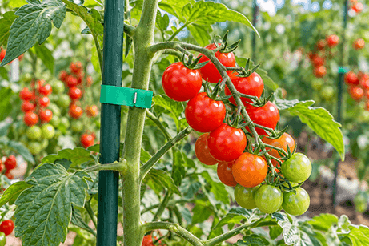
Cherry tomatoes are popular with both commercial growers and home gardeners because of their attractive appearance, sweet flavor, and continuous fruit production. However, healthy plants can grow quickly and produce long, heavy branches filled with fruit clusters.
Without proper support and regular crop management, cherry tomato plants may lean, become tangled, or suffer broken stems.
A good growing system should combine plant support, tying, pruning, watering, and regular inspection throughout the season.
Understanding Cherry Tomato Growth
Cherry tomato plants can develop rapidly under warm and suitable growing conditions.
As the main stem becomes taller, new side shoots and fruit clusters continue to appear. Some varieties can grow for a long period and require continuous support.
For this reason, growers often use:
- Stakes
- Trellis wires
- Tomato cages
- Greenhouse support lines
- Other vertical growing systems
Supporting the plant early makes later management much easier.
Support Young Plants Early
Young cherry tomato plants are easier to train while the stems are still flexible.
Once the plant reaches its support structure, the main stem can be gently guided toward a stake, wire, or vertical support.
The purpose is not to tightly fix the plant. The tie should simply keep the stem in the desired position while allowing room for continued growth.
Waiting too long can make the plant more difficult to organize because branches may already be leaning or crossing neighboring plants.
Use a Plant Tying Machine for Faster Support
When growing cherry tomatoes on a larger scale, manually cutting and tying string around every plant can require considerable time.
A plant tying machine can help workers quickly secure tomato stems to stakes or trellis structures.
The tool uses tying tape and compatible staples to form a loop around the plant and support.
This can be especially useful in:
- Commercial tomato farms
- Greenhouses
- Large vegetable gardens
- Seedling production areas
- High-density planting systems
The tie should always remain loose enough to avoid restricting the stem as it becomes thicker.
Choose the Right Tying Position
Correct tie placement is important for healthy plant development.
Avoid placing ties directly around:
- Flower clusters
- Young tomatoes
- Soft growing tips
- Damaged stem sections
A better position is usually slightly below a strong leaf node or near a stable section of the main stem.
As the plant grows taller, additional ties can be added gradually.
Several well-positioned ties can provide better support than one extremely tight connection.
Check Ties as the Plant Grows
Cherry tomato stems can increase in diameter quickly.
A tie that was loose when installed may become tighter several weeks later.
Growers should inspect older ties regularly and replace any that begin to restrict the stem.
This simple habit can help prevent unnecessary pressure on rapidly growing plants.
Manage Side Shoots
Many cherry tomato varieties produce side shoots between the main stem and leaf branches.
Depending on the growing system and tomato variety, growers may remove selected side shoots to control plant density and maintain a more organized structure.
Regular pruning can help prevent the plant from becoming excessively crowded.
When removing side shoots, use clean pruning tools and avoid unnecessarily damaging the main stem.
The exact pruning method should be selected according to the tomato variety, climate, planting density, and production system.
Support Heavy Fruit Clusters
Cherry tomatoes may be small individually, but a large cluster can add considerable weight to the plant.
As fruit develops, growers should check whether the main stem and nearby branches remain properly supported.
Avoid placing excessive pressure directly on the fruit cluster.
Instead, support the main stem and surrounding structure so the weight can be distributed more naturally.
Keep Rows Organized
Organized tomato rows make everyday farm work easier.
When stems are properly trained upward, workers can move between planting rows more conveniently.
A cleaner growing structure also makes it easier to perform tasks such as:
- Inspecting plants
- Pruning
- Checking pests
- Spraying when necessary
- Harvesting mature tomatoes
- Removing damaged leaves
Regular tying and training can therefore become part of the complete crop-management system.
Water Consistently
Cherry tomato plants require regular water, especially during flowering and fruit development.
Sudden changes between very dry and very wet soil conditions can place stress on the plants.
Watering should be adjusted according to climate, soil conditions, plant size, and production environment.
In greenhouse systems, drip irrigation is commonly used because it allows water to be delivered close to the root zone.
Avoid keeping leaves unnecessarily wet for long periods, particularly where humidity is already high.
Monitor the Plants Regularly
Frequent inspection helps growers discover problems early.
While walking through the crop rows, check for:
- Broken stems
- Loose ties
- Damaged leaves
- Weak growth
- Fruit damage
- Support problems
- Unusual plant symptoms
Early action is usually easier than trying to correct a heavily tangled or damaged plant later.
Harvest at the Right Stage
Cherry tomatoes are usually harvested when they develop the appropriate color and maturity for the target market.
Handle fruit clusters carefully because ripe tomatoes can be easily damaged.
Regular harvesting also makes it easier to monitor the condition of the plant and support system.
For commercial growers, organized rows and properly supported plants can make repeated harvesting more convenient.
Prepare Tools Before Entering the Field
During busy growing periods, workers can prepare the necessary tools before starting.
Useful equipment may include:
- Plant tying machine
- Tying tape
- Staples
- Pruning shears
- Gloves
- Harvest containers
- Replacement blades or accessories
Preparing consumables in advance helps reduce interruptions during field work.
Better Support for Better Cherry Tomato Management
Successful cherry tomato production requires continuous attention rather than a single tying or pruning operation.
As plants grow, growers need to guide stems, inspect support points, manage side shoots, protect fruit clusters, and maintain clear planting rows.
A reliable plant tying tool can become a useful part of this routine by helping workers secure growing stems quickly and consistently.
WUGENG supplies plant tying machines, tying tape, staples, pruning tools, and agricultural garden equipment for tomato growers, farms, wholesalers, and distributors.
We support wholesale orders, OEM branding, customized packaging, private-label solutions, and international distributor cooperation.
发表回复